> ## Documentation Index
> Fetch the complete documentation index at: https://docs.pipeshub.com/llms.txt
> Use this file to discover all available pages before exploring further.
# LibreChat
> Connect LibreChat to the PipesHub MCP server
LibreChat supports remote MCP servers with OAuth authentication via its custom connectors UI. This lets you connect PipesHub tools to any model available in your LibreChat instance.
Before you start, create an OAuth app in PipesHub and note your **Client ID** and **Client Secret**. See [MCP Server Overview](/mcp/overview#step-1-create-an-oauth-app).
 ## Configuration
Log in to your LibreChat instance and navigate to the **MCP Servers** settings panel.
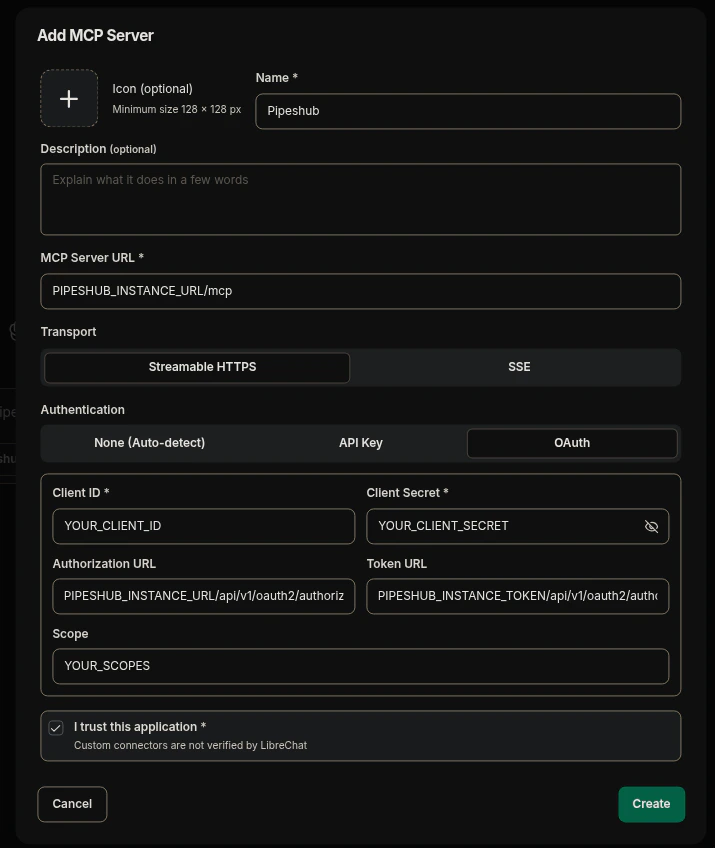
Click **Add** to create a new custom MCP connector and fill in the details:
* **Name**: `Pipeshub` (or any name you prefer)
* **MCP Server URL**: `PIPESHUB_INSTANCE_URL/mcp`
* **Transport**: Select **Streamable HTTPS**
* **Authentication**: Select **OAuth**
Enter your OAuth credentials:
* **Client ID**: `YOUR_CLIENT_ID`
* **Client Secret**: `YOUR_CLIENT_SECRET`
* **Authorization URL**: `PIPESHUB_INSTANCE_URL/api/v1/oauth2/authorize`
* **Token URL**: `PIPESHUB_INSTANCE_URL/api/v1/oauth2/token`
* **Scope**: `openid profile email offline_access semantic:write conversation:write conversation:chat kb:read team:read user:read config:read`
Check **I trust this application** and click **Add** to save the connector.
After adding, LibreChat generates a **Redirect URI** displayed in the connector settings panel (next to the copy button), in the format:
```
http://localhost:3080/api/mcp//oauth/callback
```
Copy the Redirect URI and register it as an allowed redirect URI in your PipesHub OAuth app (see [Step 1](/mcp/overview#step-1-create-an-oauth-app)).
Return to the LibreChat connector and click **Update** to initiate the OAuth flow — you'll be redirected to PipesHub's login page to authenticate and grant permissions.
## Redirect URI
LibreChat generates the redirect URI **after** the connector is created. The URI follows this format:
```
http://localhost:3080/api/mcp//oauth/callback
```
Where `` is the unique identifier assigned by LibreChat (visible at the top of the connector settings as "Unique Server Identifier"). You must copy this URI and add it to your PipesHub OAuth app's allowed redirect URIs **before** authenticating.
If your LibreChat instance runs on a different host or port, the URI will reflect that (e.g., `https://chat.example.com/api/mcp/pipeshub/oauth/callback`).
## Scopes
LibreChat allows you to specify the OAuth scopes in the **Scope** field. Use a space-separated list:
```
openid email
```
To request PipesHub-specific scopes, add them to the scope field:
```
openid profile email offline_access semantic:write conversation:write conversation:chat kb:read team:read user:read config:read
```
The scopes you request must match the scopes granted to your OAuth app in PipesHub. See [Customizing Default Scopes](/mcp/overview#customizing-default-scopes) for details.
## Configuration
Log in to your LibreChat instance and navigate to the **MCP Servers** settings panel.
Click **Add** to create a new custom MCP connector and fill in the details:
* **Name**: `Pipeshub` (or any name you prefer)
* **MCP Server URL**: `PIPESHUB_INSTANCE_URL/mcp`
* **Transport**: Select **Streamable HTTPS**
* **Authentication**: Select **OAuth**
Enter your OAuth credentials:
* **Client ID**: `YOUR_CLIENT_ID`
* **Client Secret**: `YOUR_CLIENT_SECRET`
* **Authorization URL**: `PIPESHUB_INSTANCE_URL/api/v1/oauth2/authorize`
* **Token URL**: `PIPESHUB_INSTANCE_URL/api/v1/oauth2/token`
* **Scope**: `openid profile email offline_access semantic:write conversation:write conversation:chat kb:read team:read user:read config:read`
Check **I trust this application** and click **Add** to save the connector.
After adding, LibreChat generates a **Redirect URI** displayed in the connector settings panel (next to the copy button), in the format:
```
http://localhost:3080/api/mcp//oauth/callback
```
Copy the Redirect URI and register it as an allowed redirect URI in your PipesHub OAuth app (see [Step 1](/mcp/overview#step-1-create-an-oauth-app)).
Return to the LibreChat connector and click **Update** to initiate the OAuth flow — you'll be redirected to PipesHub's login page to authenticate and grant permissions.
## Redirect URI
LibreChat generates the redirect URI **after** the connector is created. The URI follows this format:
```
http://localhost:3080/api/mcp//oauth/callback
```
Where `` is the unique identifier assigned by LibreChat (visible at the top of the connector settings as "Unique Server Identifier"). You must copy this URI and add it to your PipesHub OAuth app's allowed redirect URIs **before** authenticating.
If your LibreChat instance runs on a different host or port, the URI will reflect that (e.g., `https://chat.example.com/api/mcp/pipeshub/oauth/callback`).
## Scopes
LibreChat allows you to specify the OAuth scopes in the **Scope** field. Use a space-separated list:
```
openid email
```
To request PipesHub-specific scopes, add them to the scope field:
```
openid profile email offline_access semantic:write conversation:write conversation:chat kb:read team:read user:read config:read
```
The scopes you request must match the scopes granted to your OAuth app in PipesHub. See [Customizing Default Scopes](/mcp/overview#customizing-default-scopes) for details.