

Confluence Data Center
Self-hosted team workspace and documentation platform
✅ Ready📖 Documentation Available
Overview
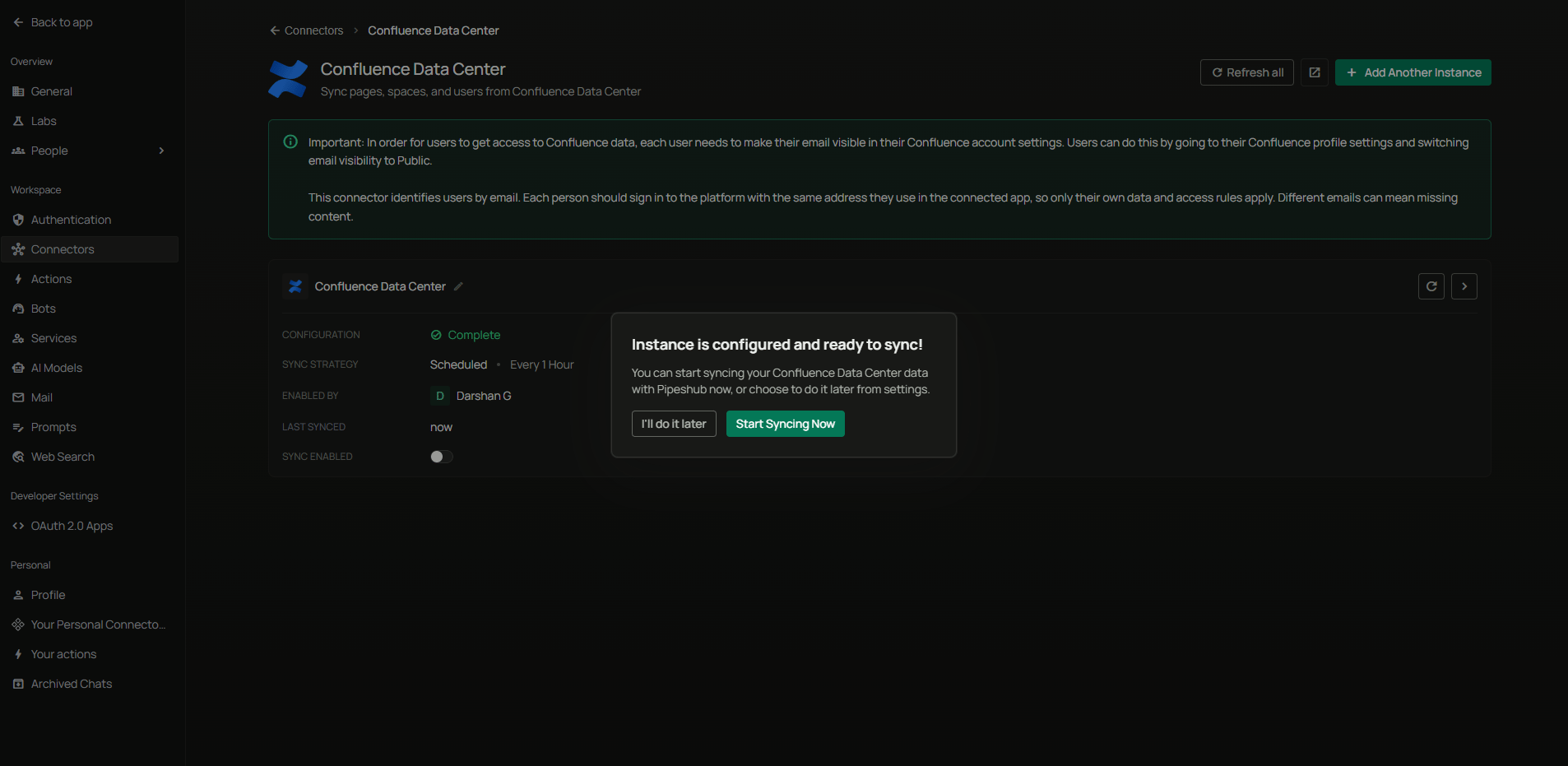
Confluence Data Center is the version of Confluence that you install and run on your own servers. Atlassian does not host it for you. The Confluence Data Center connector syncs spaces, pages, blog posts, comments, attachments, and users from your instance. It keeps space permissions and page restrictions, so each user in PipesHub only sees what they can already see in Confluence.If Atlassian hosts your Confluence for you, that is Confluence Cloud. Use the Confluence Cloud connector instead. The two connectors are not interchangeable.
What Gets Synced
Configuration Guide
The Confluence Data Center connector supports two ways to sign in: Personal Access Token (PAT) and Basic Authentication. Both sync the same data.Prerequisites
Check these before you start:Prerequisite: Email visibility
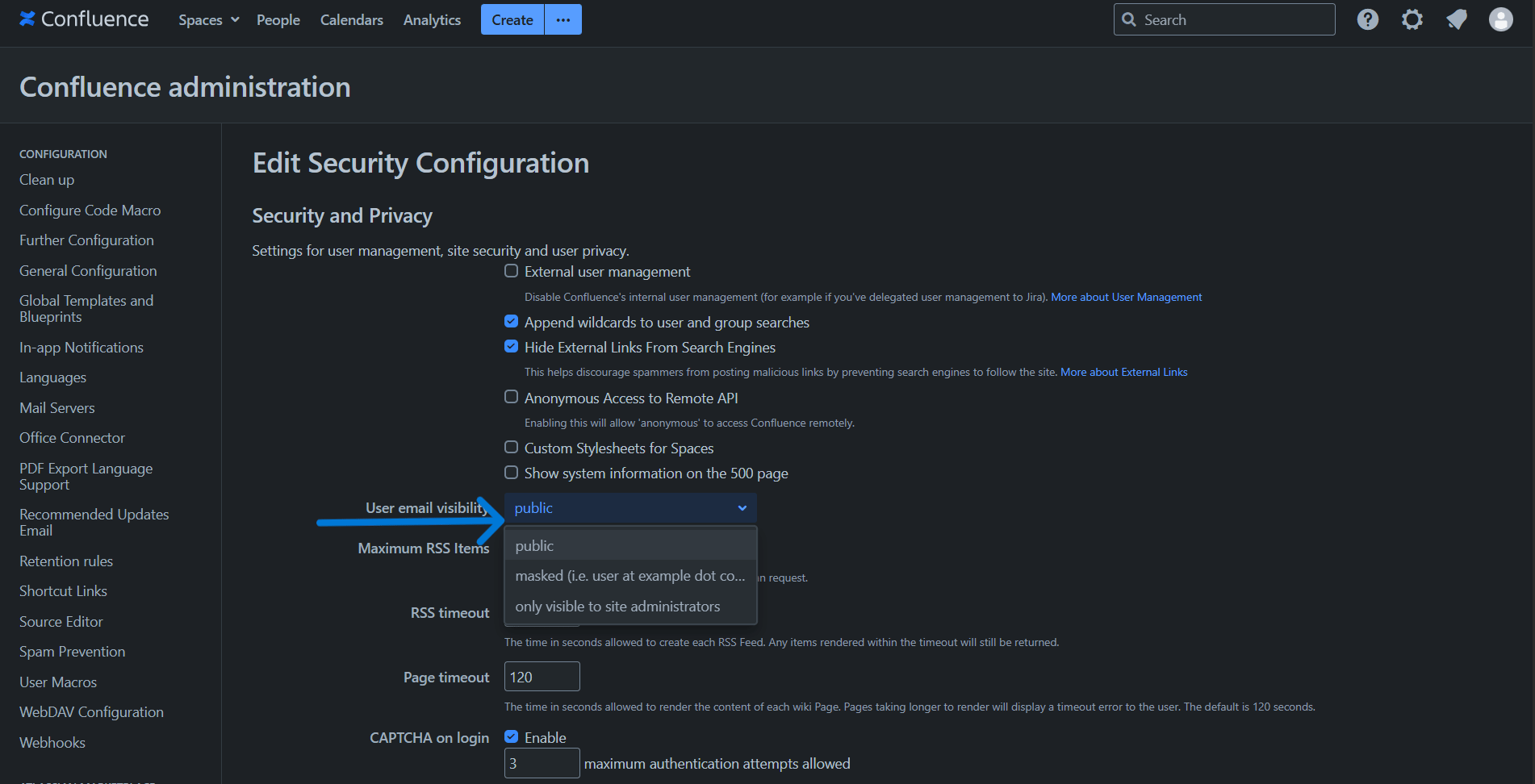
On Confluence Data Center, email visibility is a global setting that an administrator controls. Users cannot change it for themselves, unlike Confluence Cloud where each person sets their own.
- Go to Administration → General Configuration.
- Open Security Configuration and click Edit.
- Set User email visibility to Public.
- Save.
Choose how to sign in
- Personal Access Token
- Basic Authentication
Step 1: Create a Personal Access Token in Confluence
- Sign in to your Confluence with the account you want the connector to use.
- Click your profile picture in the top right, then select Settings.
- Open the Personal Access Tokens tab.
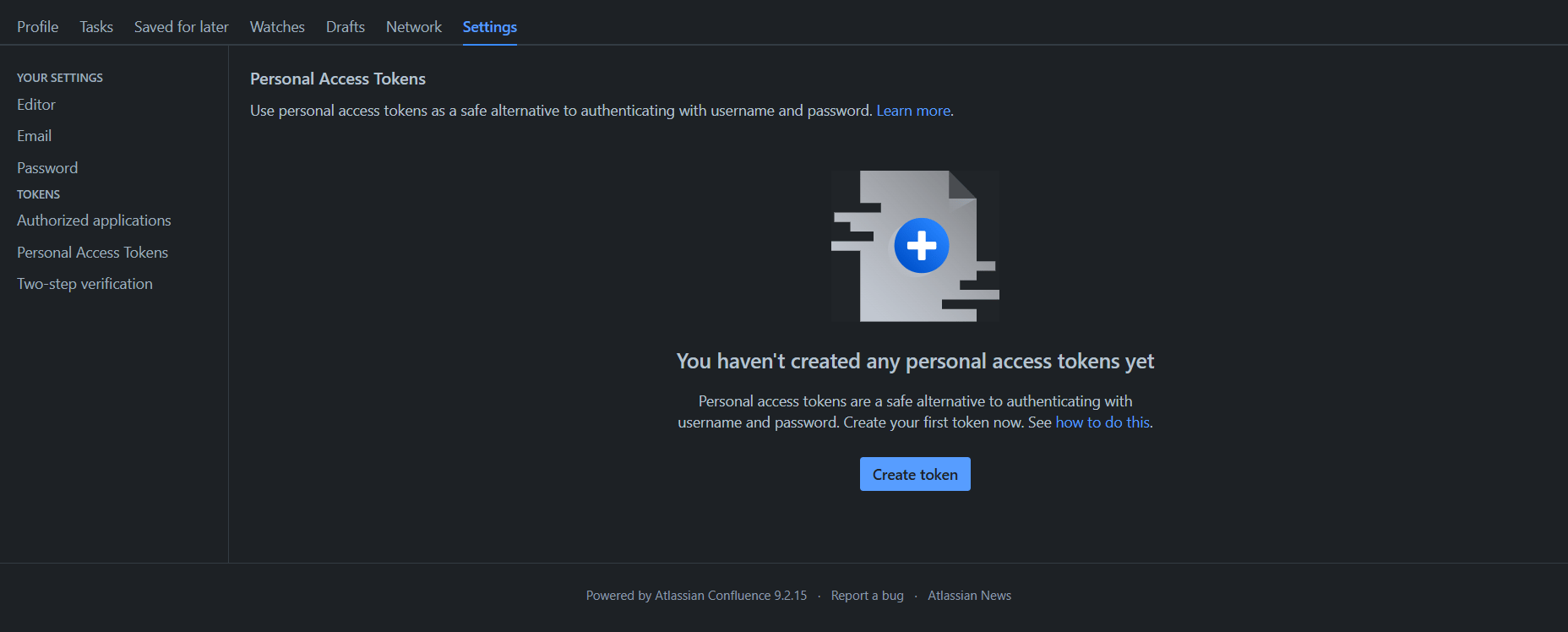
- Click Create token.
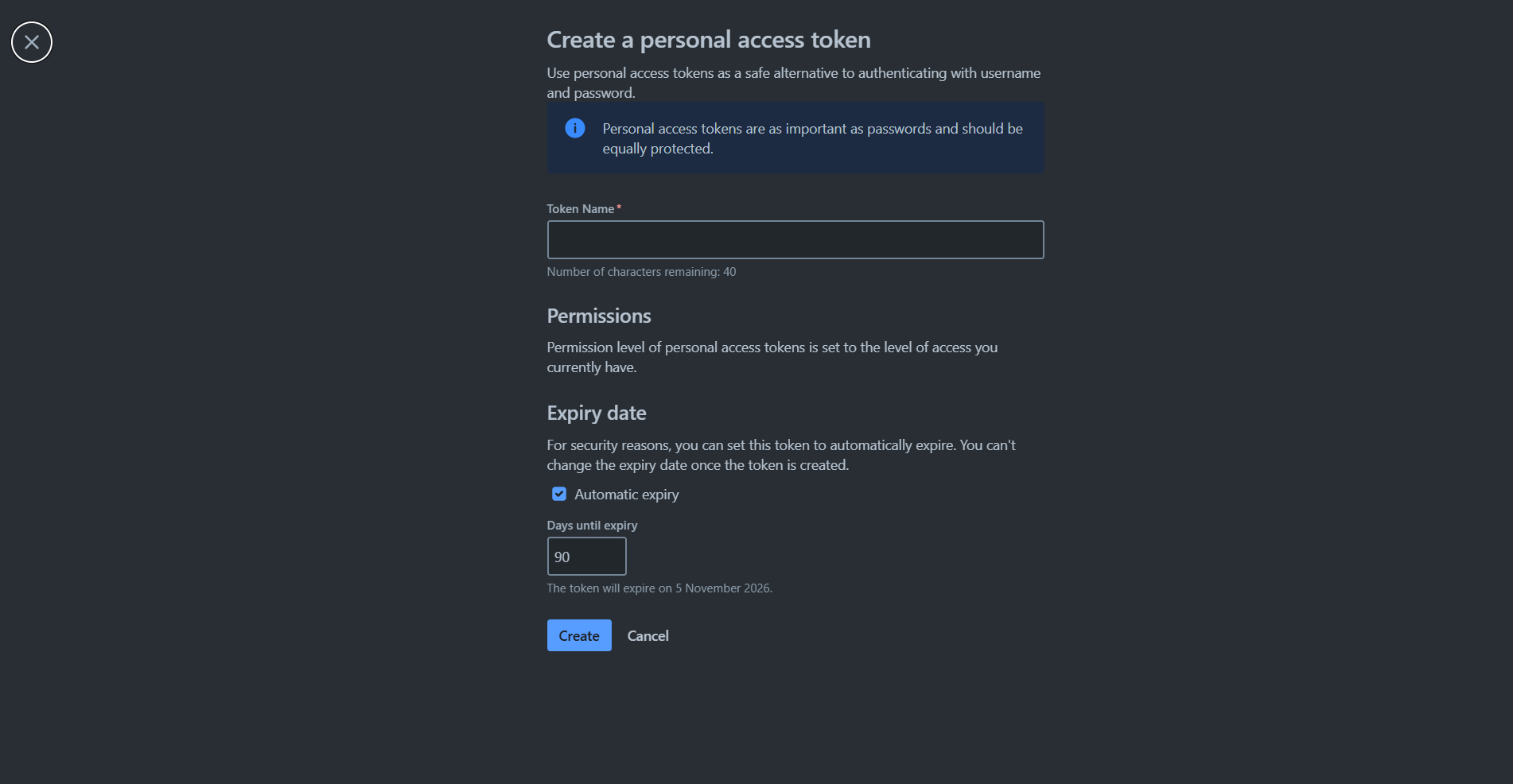
- Give it a name you will recognise, such as
PipesHub Confluence Connector. - Set an expiry, or turn off Automatic expiry if your policy allows tokens that do not expire.
- Click Create.
- Confluence shows the token once. Copy it and store it somewhere safe.
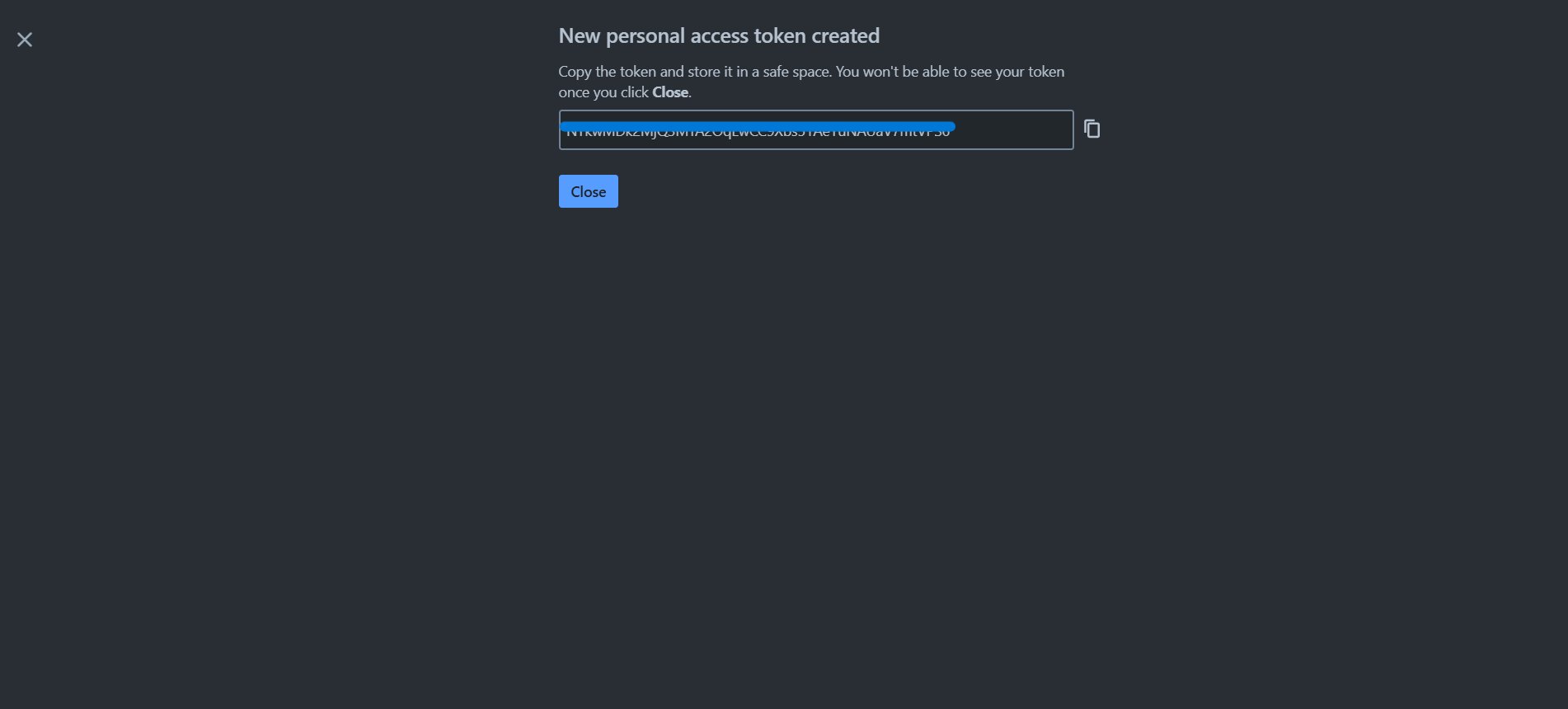
A token has the same access as the account that created it. Create it from a Confluence admin account so the connector can read every space, the full user list, and the audit log.
Step 2: Authenticate Instance tab — enter your credentials
- In PipesHub, go to Workspace Settings → Connectors, find Confluence Data Center, and click + Setup.
- The connector panel opens as a drawer on the right.
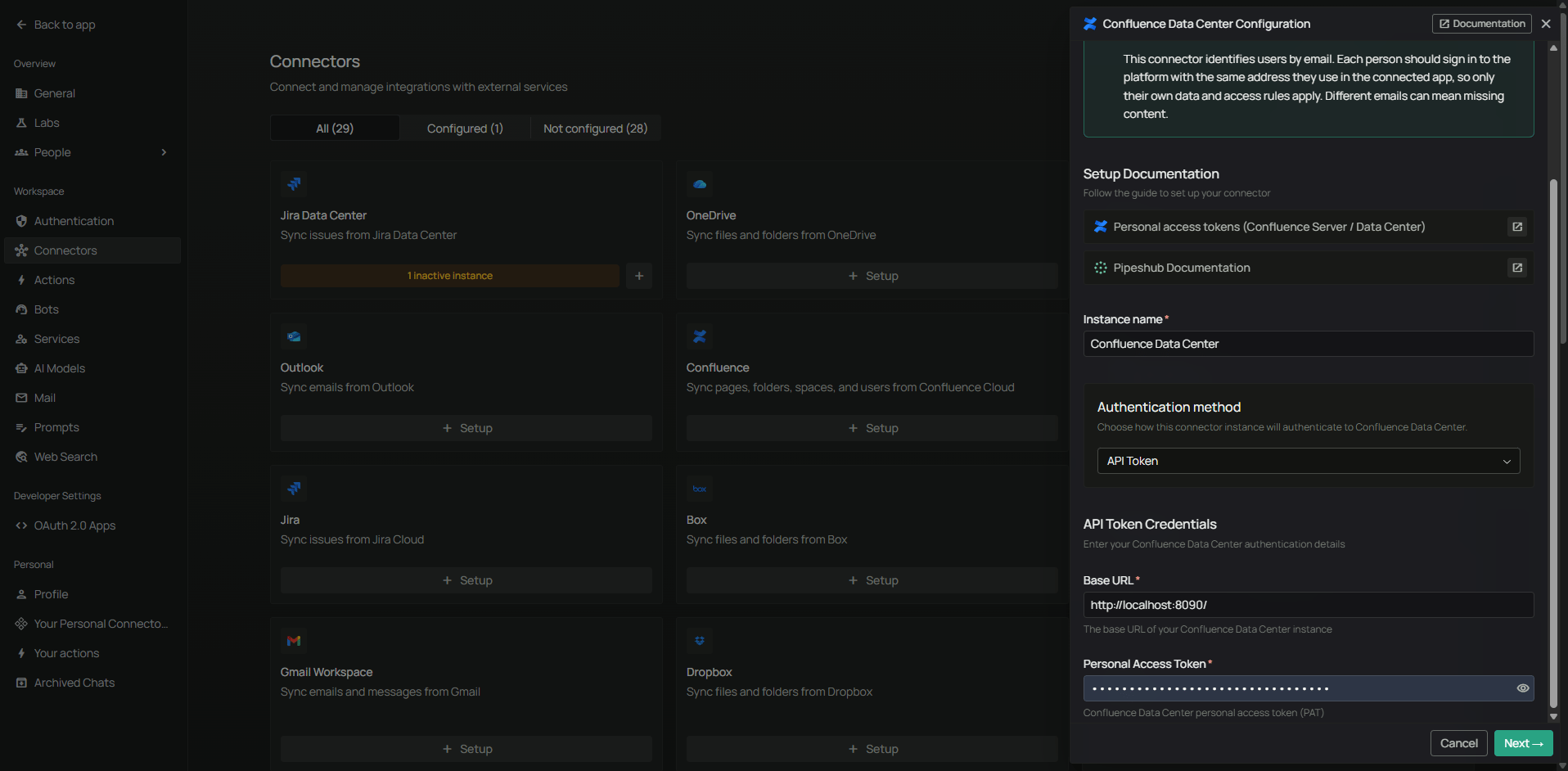
- On the Authenticate Instance tab, select Personal Access Token in the Authentication method dropdown.
- Enter:
- Base URL — the root URL of your Confluence, such as
https://confluence.yourcompany.com, with no trailing slash - Personal Access Token — the token you copied in Step 1
- Base URL — the root URL of your Confluence, such as
- Click Next. PipesHub checks the credentials and moves you to the Configure Records tab.
Step 3: Configure Records tab
See Configure Records below. The options are the same for both sign-in methods.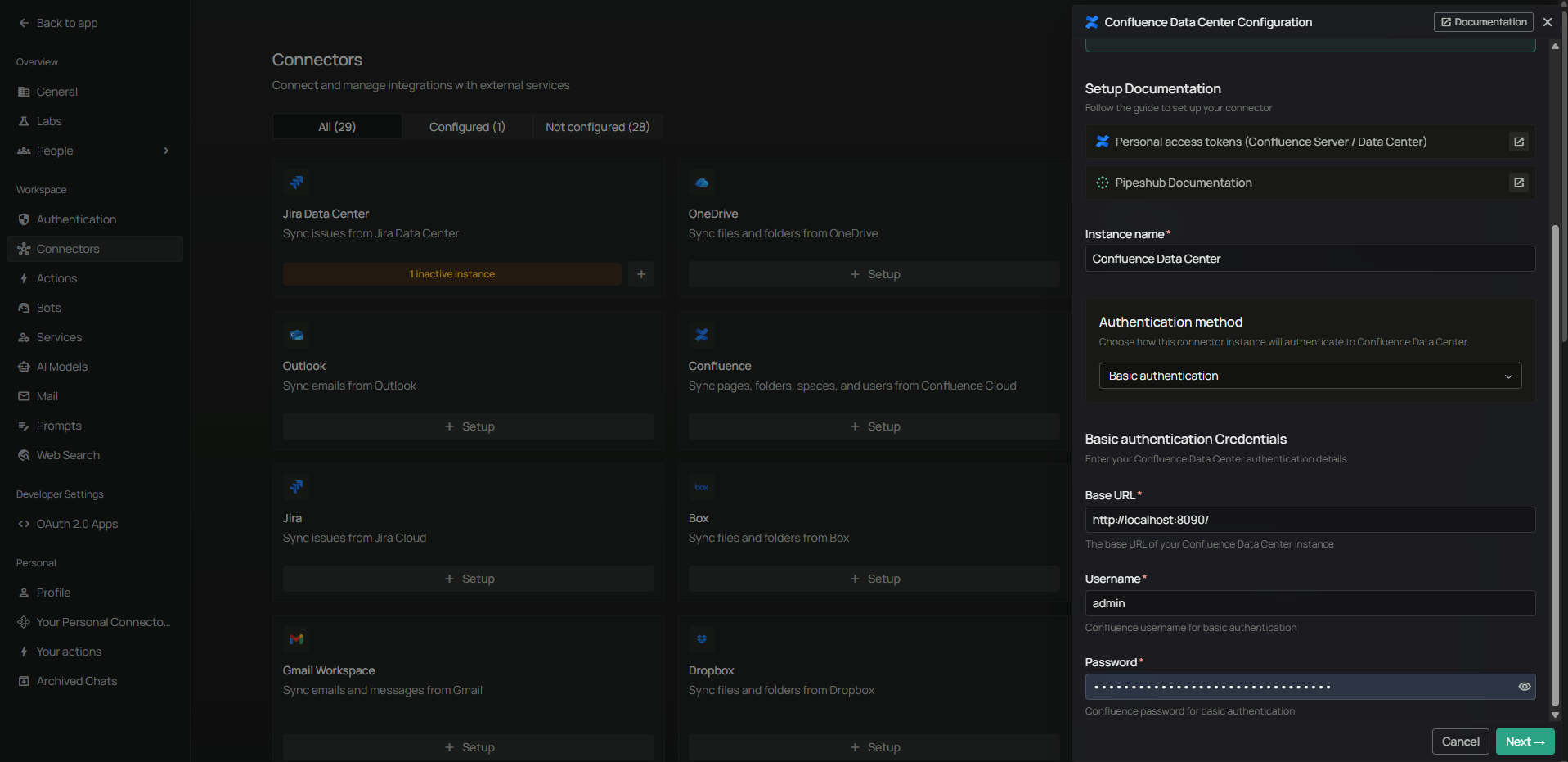
Configure Records
On the Configure Records tab, you choose how often the connector syncs and what it syncs. Sync settings — set these first:- Sync Strategy —
ScheduledorManual. - Sync Interval — how often to sync (default: 60 minutes).
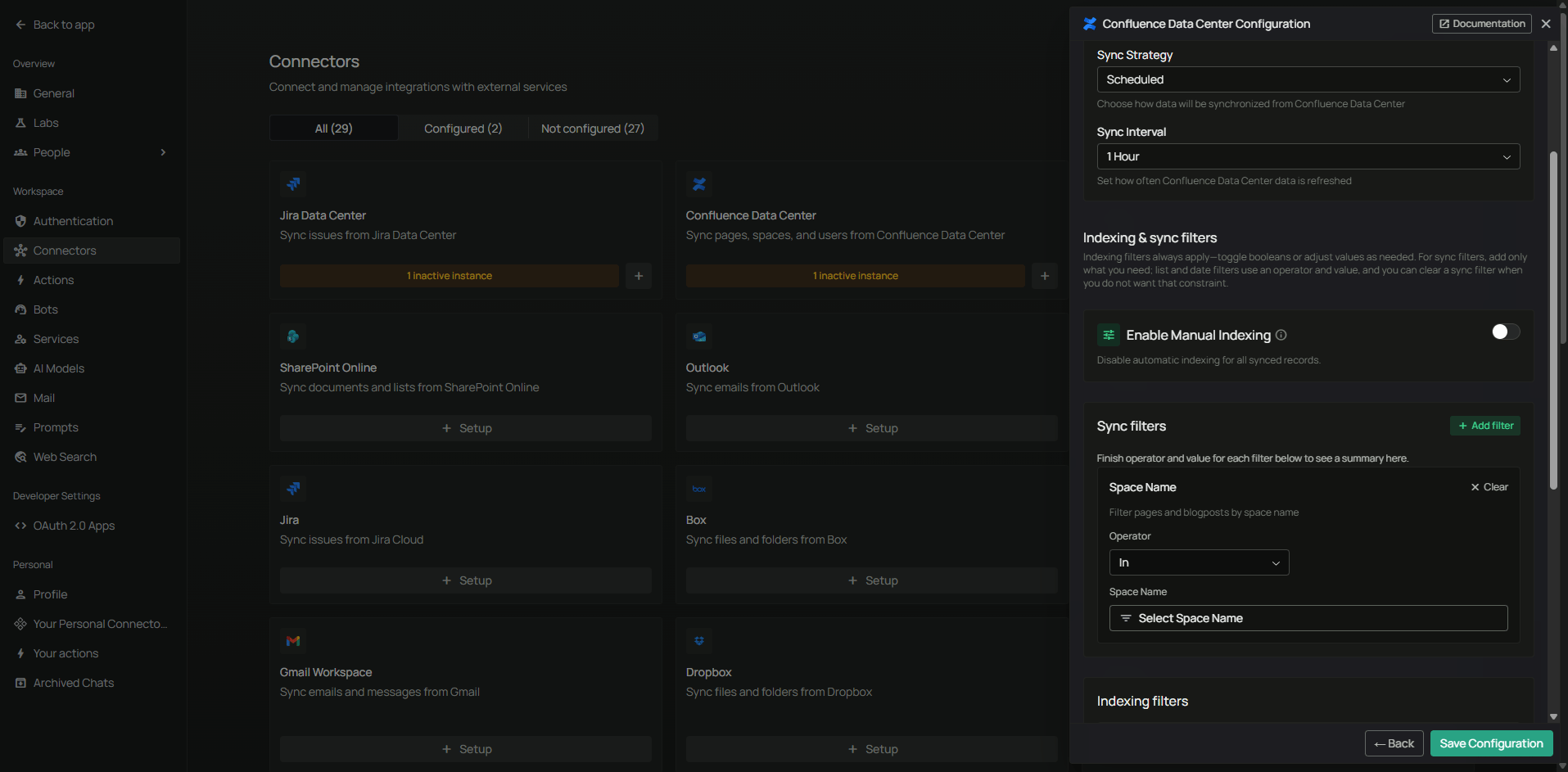
Scheduled sync runs on its own at the interval you set. Manual sync runs only when you start it. Real-time sync is not available for Confluence Data Center.
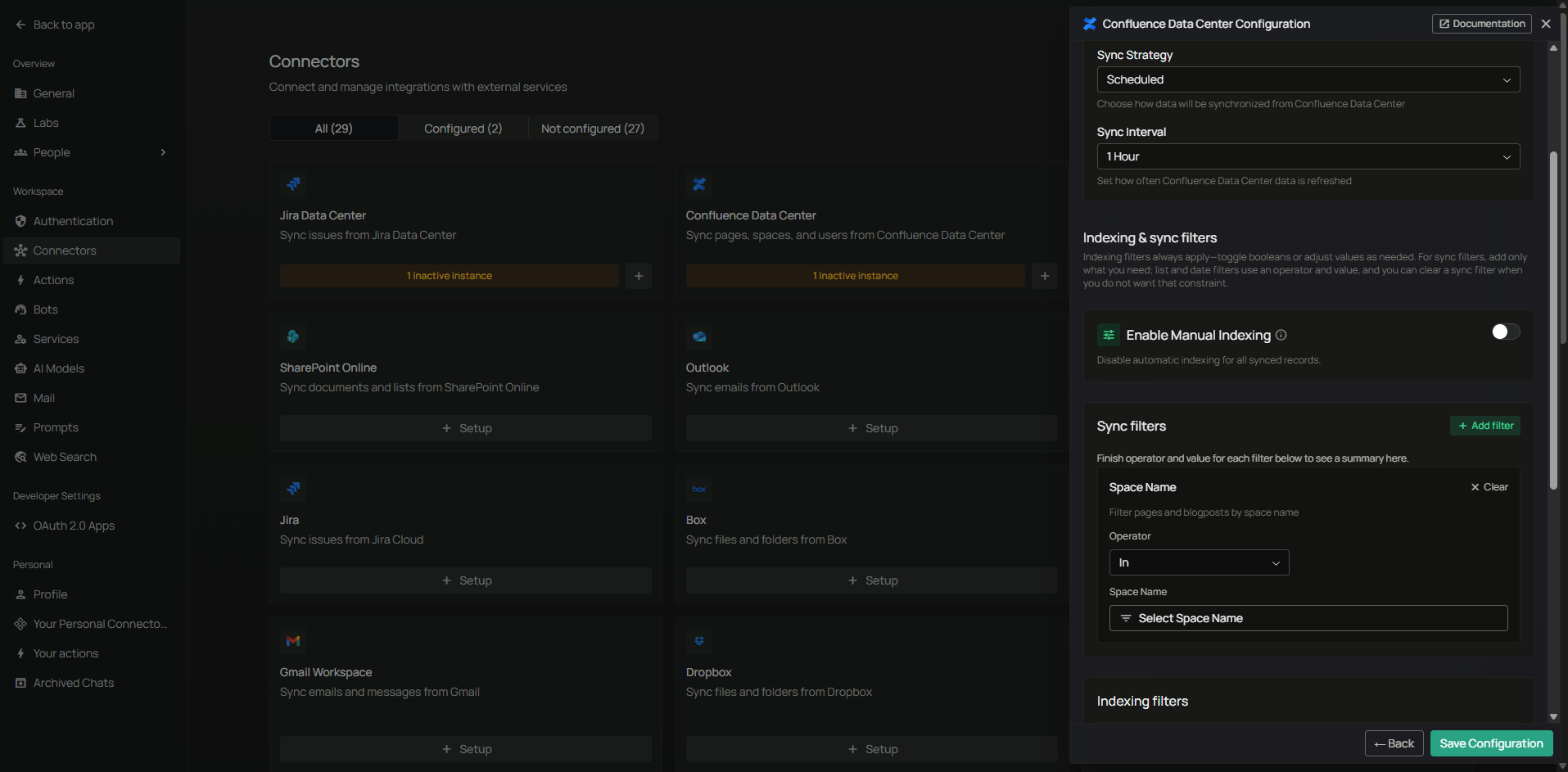
- Space Name — pick which spaces to sync.
- Operator:
Into include only those spaces, orNot Into exclude them - Selection: a searchable dropdown of the spaces your account can see
- Operator:
- Page Name — pick specific pages. Picking a page also includes its child pages.
- Blogpost Name — pick specific blog posts.
- Modified Date — filter by last change date. Operators:
Is After,Is Before,Is Between. - Created Date — filter by creation date. Same operators.
In the Confluence Cloud connector you type space keys and page IDs by hand. Here you pick them from dropdowns instead. The lists are loaded from your instance, so you do not need to find keys or IDs in the URL.
- Pages: Index Pages / Index Page Attachments / Index Page Comments (all on by default)
- Blog posts: Index Blogposts / Index Blogpost Attachments / Index Blogpost Comments (all on by default)
- Sync only the Engineering space: Space Name →
In→ select “Engineering” - Skip archived spaces: Space Name →
Not In→ select the archived ones - Sync one documentation tree: Page Name →
In→ select the parent page - Recent content only: Modified Date →
Is After→2024-06-01 - Pages but not attachments: turn off Index Page Attachments
Supported Features
The Confluence Data Center connector syncs:- Spaces — every space your account can see, with their permissions
- Pages — full page content with formatting preserved
- Blog Posts — all blog post content and metadata
- Comments — footer and inline comments, including whether an inline comment is resolved
- Attachments — files attached to pages and blog posts
- Users — user profiles and account information
- Groups — user groups and memberships
- Permissions — space permissions and page or blog view restrictions
- Audit Log — used to spot permission changes between syncs
Want agents to act in Confluence? This connector only syncs data into PipesHub. To let agents create and update pages, set up the Confluence Data Center toolset as well.
Useful Links
- Personal access tokens (Confluence Server/Data Center): confluence.atlassian.com/doc/using-personal-access-tokens-1007111435.html
- Confluence Server/DC REST API: developer.atlassian.com/server/confluence/confluence-server-rest-api/
- CONFSERVER-78176 (space permissions REST endpoint): jira.atlassian.com/browse/CONFSERVER-78176
Troubleshooting
Troubleshooting
Troubleshooting
Common issues
Spaces fail to sync with a version error:- Your Confluence is older than 9.1, so it cannot report space permissions over the REST API. The connector stops on purpose rather than syncing content with no permissions. Upgrade to 9.1 or later.
- Start with
https:// - No trailing slash. Use
https://confluence.yourcompany.com, nothttps://confluence.yourcompany.com/ - No page paths like
/display/SPACEor/pages/viewpage.action - If Confluence runs under a path, include it:
https://company.com/confluence
- Check for extra spaces at the start or end of the token
- The token may have expired or been revoked. Create a new one from Settings → Personal Access Tokens
- Your Confluence version may be older than 7.9 and not support tokens. Use Basic Authentication instead
- Use the Confluence username, not the email address
- The account may be CAPTCHA-locked after failed sign-ins. Sign in once in a browser to clear it
- Check that PipesHub can reach the base URL through your firewall, VPN, or allowlist
- If your instance uses a self-signed or internal certificate, PipesHub needs to trust that certificate
- Users are skipped when email addresses are hidden. Ask a Confluence administrator to make them visible, then sync again
- Their permissions are kept in the meantime and move onto their account once they sync
- Check that the connector shows Active
- Check that the account can view the spaces you expect
- Check that the spaces are not archived
- Read the sync logs for the exact error
- Check that the account has read access to that content
- Check the space permissions in Confluence
- Check for page restrictions that limit who can see the page
- That is expected. Folders only exist in Confluence Cloud. Pages inside them sync as normal.
Data Sync Behavior
Synchronization Process
Synchronization Process
Sync order
Each sync runs these steps in order:First sync
- Fetches all content from every space your account can see
- Indexes pages, blog posts, attachments, and comments based on your indexing filters
- How long it takes depends on how much content you have
Later syncs
- Uses timestamps to find changed content
- Only syncs pages and blog posts that are new or changed since the last sync
- A separate audit log pass catches permission and restriction changes, because those do not change a page’s last-modified time
How permissions work
- Space permissions come from
GET /rest/api/space/{spaceKey}/permissions, which needs Confluence Data Center 9.1 or later - Page and blog restrictions are read as effective view restrictions. Only real read restrictions change who can see a page. A restriction that only limits editing still lets people read the page based on the space permissions
- Public spaces — if a space allows anonymous read access, it is treated as public and per-user permissions are skipped
- Unknown users — permissions for users whose email is not known yet are held on a placeholder and moved to the real user once that user syncs
How Data Center differs from Confluence Cloud
FAQ
Can I use OAuth with this connector?
Can I use OAuth with this connector?
No. This connector supports Personal Access Token and Basic Authentication only. OAuth apps created in the Atlassian Developer Console are for Confluence Cloud and will not work here.
Should I use a Personal Access Token or Basic Authentication?
Should I use a Personal Access Token or Basic Authentication?
Use a Personal Access Token unless your instance cannot create them. Both sync the same data.
What is the difference between the Confluence Cloud and Confluence Data Center connectors?
What is the difference between the Confluence Cloud and Confluence Data Center connectors?
Pick the one that matches your setup. They cannot be swapped.
Why do I need Confluence Data Center 9.1 or later?
Why do I need Confluence Data Center 9.1 or later?
Space permissions were only added to the REST API in Confluence Data Center 9.1 (CONFSERVER-78176). Without that, the connector cannot tell who is allowed to see a space. If it indexed content anyway, that content would either be hidden from everyone or shown to too many people. So it stops with a clear error instead.
Can I sync only certain Confluence spaces?
Can I sync only certain Confluence spaces?
Yes. On the Configure Records tab, use the Space Name filter with the
In operator and pick the spaces you want. Use Not In to leave spaces out instead.Can I sync only certain pages in a space?
Can I sync only certain pages in a space?
Yes. Use the Page Name filter with the
In operator and pick the pages you want. Picking a page also includes its child pages, so you can sync a single documentation tree.My searches return nothing. What should I check?
My searches return nothing. What should I check?
Check these in order:
- The sync has not finished. Go to Settings → Connectors and check the sync status, then look in All Records for the pages you expect.
- Email addresses are hidden. If Confluence hides email addresses, you may not have been synced as a user yet. Ask a Confluence administrator to make them visible, then wait for the next sync.
- Your filters are too narrow. Check the Space Name, Page Name, and date filters on the Configure Records tab.
- Indexing is off. Check that Index Pages and the related toggles are turned on.
Ready to Get Started?
Connect your self-hosted Confluence Data Center instance to PipesHub in a few minutes. Follow the steps above to search every space and page across your Confluence content.