
Groq Configuration
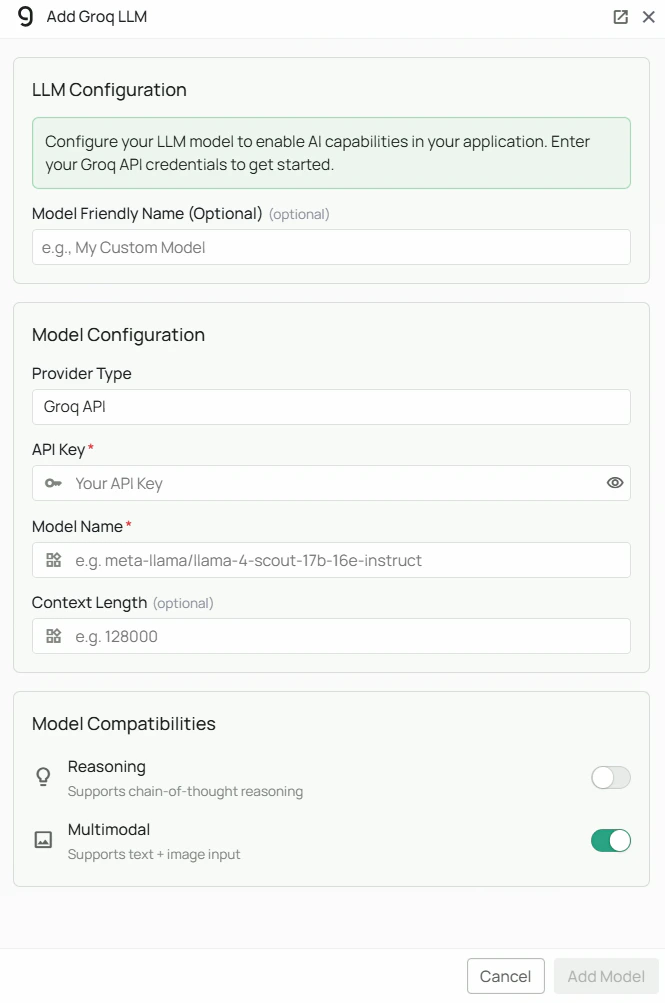
Required Fields
API Key *
The API Key is required to authenticate your requests to Groq’s services. How to obtain an API Key:- Log in to the Groq Console
- Navigate to the “API Keys” section
- Click “Create API Key”
- Copy the generated API key
Model Name *
The Model Name field defines which model you want to run on Groq’s infrastructure. Popular models available on Groq:meta-llama/llama-4-scout-17b-16e-instruct- Meta’s Llama 4 Scout, a fast and capable instruction-following model
- For fast, general-purpose instruction-following, select
meta-llama/llama-4-scout-17b-16e-instruct - Check Groq’s model documentation for the full list of supported models
Configuration Steps
As shown in the image above:- Click Configure on the Groq provider card
- Enter your Groq API Key in the designated field (marked with *)
- Specify your desired Model Name (marked with *)
- Click Add Model to save and validate your credentials
Both the API Key and Model Name are required fields to successfully configure Groq integration.
Usage Considerations
- API usage will count against your Groq account’s quota and billing
- Different models have different pricing — check Groq’s pricing page for details
- Groq provides:
- Ultra-low latency inference via dedicated LPU hardware
- High throughput for concurrent requests
- Support for popular open-source models including Llama and Mixtral families
Troubleshooting
- If you encounter authentication errors, verify your API key is correct and has not expired
- Ensure your Groq account has billing set up if you are on a paid tier
- Check that the model name is spelled correctly — Groq uses a
provider/model-nameformat for most models - Verify that your account has access to the specific model you have selected
- If you are experiencing rate limits, check your usage in the Groq Console dashboard